
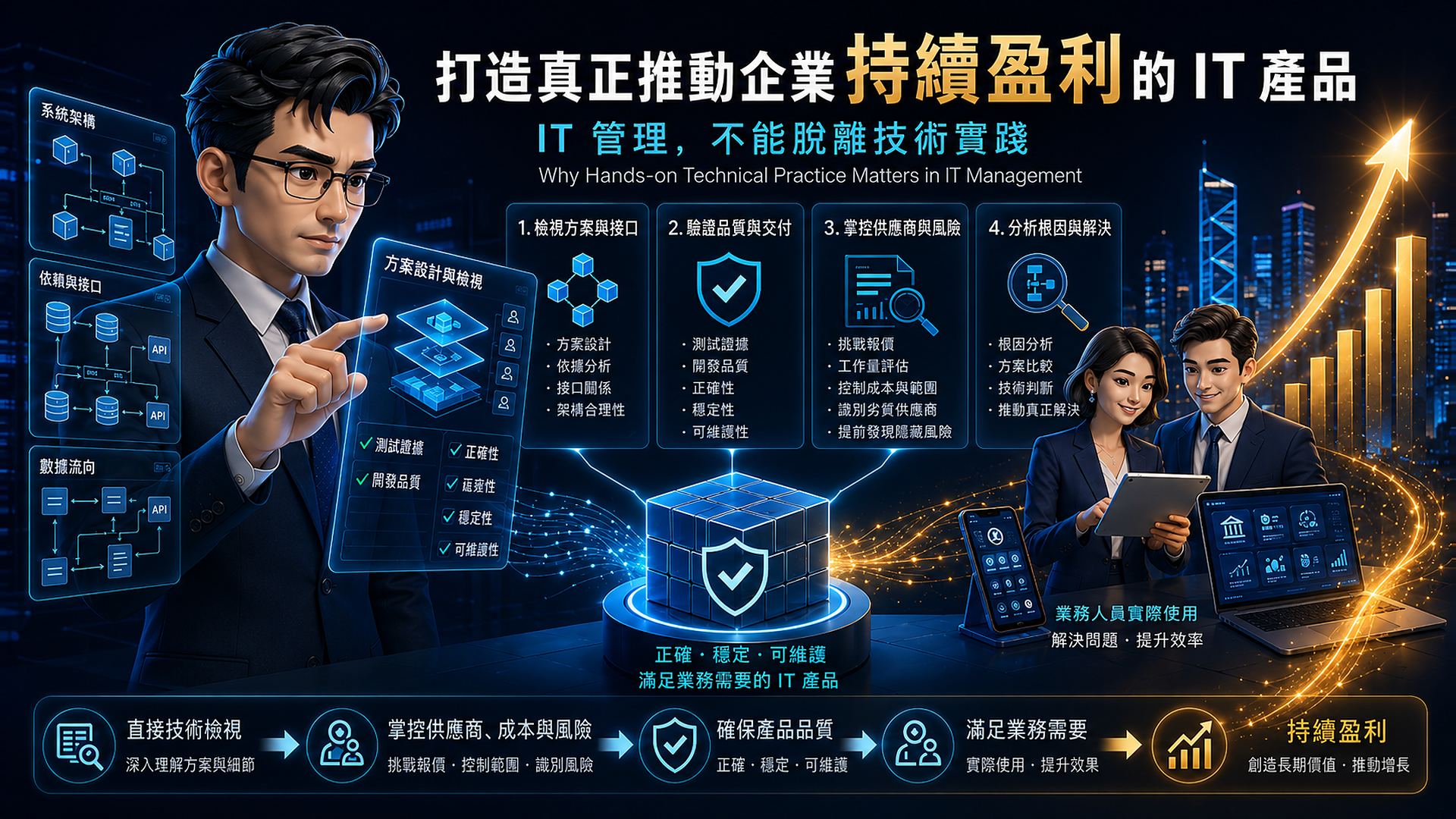
Businesses do not merely need IT managers who organise meetings, track progress and produce reports. They need leaders who retain enough hands-on technical depth to make independent judgements, review delivery directly and translate product quality into sustainable business value.
For banks, financial institutions and other organisations that depend heavily on digital products, correctness, stability, security and maintainability directly affect customer experience, operational efficiency, risk, cost and long-term profitability.
The purpose of hands-on technical practice is not to make an IT Manager perform every development task. It is to preserve the ability to review, challenge, validate and judge directly—so that solutions, vendors, cost, scope, risk, quality and root causes can be managed with real evidence.
Technical practice is the foundation of sound IT management judgement
Real insight comes from practice. Without practice, everything remains theoretical.
Reading, certifications and management frameworks are all valuable, but when a manager becomes completely detached from delivery, knowledge can easily remain at the level of concepts, presentations and second-hand descriptions.
For many technology-delivery leadership roles, practical progression from Programmer to Analyst Programmer and System Analyst provides an important foundation for sound technical judgement. After advancing to IT Manager or IT Head, the emphasis naturally expands to strategy, people, stakeholders, budgets and governance. Greater management responsibility, however, should not mean complete separation from technical practice.
Direct review is not micromanagement, nor does it mean replacing developers or architects. It means maintaining enough technical depth to examine solution designs at critical points, understand dependencies and interfaces, inspect testing evidence, assess development quality and make an independent judgement about what is actually being delivered.
Four management capabilities created by hands-on technical practice
-
Review solutions, dependencies and interfaces
A technically grounded manager can understand solution design, system dependencies, interfaces and architectural trade-offs directly. This makes it possible to judge whether a proposal is complete, feasible and aligned with genuine business requirements—not merely accept a summary provided by a vendor or delivery team.
-
Control vendors, cost, scope and risk
Hands-on experience provides a basis for challenging quotations, effort estimates and timelines. It helps identify vendors with weak delivery capability, unstable quality or unreasonable pricing, while exposing the cost implications of vague scope, technical debt, dependencies and hidden risks earlier.
-
Validate quality and delivery outcomes
Acceptance should not be reduced to a completion percentage or a milestone marked as done. Managers need to confirm correctness, stability, security and maintainability, and determine whether testing evidence and development quality are strong enough for real business use.
-
Analyse root causes and drive genuine resolution
When problems occur, technically capable managers can analyse root causes, compare solutions, understand the impact and assess remediation risk. They can drive genuine resolution instead of relying on prolonged coordination, repeated questioning and second-hand relaying of information.
When management becomes detached from technical practice
Without the ability to review work directly and make an independent judgement, IT managers can easily become limited to the following:
- Rely on vendors’ descriptions of solutions, timelines, effort and quality without being able to validate them independently.
- Treat progress updates, meetings and status reports as the main sources of truth while lacking visibility into the actual state of delivery.
- Focus acceptance on whether work has been “completed” rather than whether it is correct, stable, secure and maintainable.
- Struggle to determine root causes directly, leaving them to coordinate multiple teams, ask repeated questions and relay information between parties.
From technical judgement to sustainable profitability
Business value does not arise automatically from “understanding technology”. It is created through a complete and verifiable management chain:
- Direct technical review
- Control vendors, cost and risk
- Assure product quality
- Meet business needs
- Drive sustainable profitability
When an IT product is more correct, stable, secure and maintainable, the business can rely on it. When scope, cost, vendors and risk are controlled earlier and with greater accuracy, the organisation reduces rework, incidents, delays and unnecessary expenditure. Together, these outcomes support efficiency, customer trust, operational continuity and long-term profitability.
Meetings, progress reports and stakeholder communication remain essential, but they should not replace direct judgement. Mature IT management connects technology, delivery, people and business—producing IT products that are genuinely used, operate reliably and continue to create value.
Outstanding IT managers are not simply good at relaying technical information. They convert technical judgement into product quality, business outcomes and long-term value.
My practical work
For more details, please visit the website that I personally designed, developed and manage. Professional exchange and discussion are welcome: